
Imagine playing a video game like Fortnite but whenever you try to look Around a corner or enter a room the game freezes for a few seconds to load the graphic. You’d curse and rage quit in a minute, right?
Table of Contents
Well, that is the same experience you’ll encounter when you visit a website massive, unoptimized image files. It will ruin the whole vibe and nobody would be ready to have such patience.
So why are huge images secretly killing your favorite websites? How does it destroy their Google rankings? And how can a web designer fix the issue without much tech magic?
When Pretty Graphics Make a Site Crawl
Whether you are website owner or a developer, you always want the website to have high resolution graphics. Thew vibrant images, crisp illustrations and cool background will definitely make you website look premium. But there is a hidden trap; the file size.
If as web designer uploads a beautiful photo, says from a stock image site like Magnific, or an uncompressed imager taken by a high-end camera or modern phones, a single file could be as large as 10 megabytes (MB) or even more. For a device on cellular or metered network, this size is a massive boulder it has to carry.
When a regular user clicks on a link, they expect the page to load almost instantly. If the web page takes more than two seconds to load because of the image load, most users will hit the “back” button or end the session. This is what we refer to as a “bounce” and it is no good news for you as a website owner.
The SEO Connection: Google Tracks the Clock
You already know google as the face of search, but how does it decide which website get to be on the first page and which ones get stuffed 10+ pages into the search?
User experience is open of the major focuses of google when it pre4sents website on search results. If it recommends a painfully slow page then they will lose the users’ trust.
For this reason, google search bots will literally track the number of seconds and milliseconds it takes for a page to load. Slow pages will be penalized and pushed on the back of the search result lines. So even if your siter has the best of graphics and illustrations in thew world, if it is slow, no one will ever find it.
The Best SEO Practice: Meet Image Compression
So, what’s the fix? Should we use ugly blurry and pixelated images so that we achieve the loading speed we want?
Not really! Image compression and modern web file formats are your kryptonite.
Instead of saving your images as traditional, heavy PNGs or JPEGs, smart designers will convert them into next-generation web formats like WebP or AVIF.
WebP and AVIF formats use advance math to shrink image’s file size by up to 80% and the best part is that human eye can’t even tell the difference.
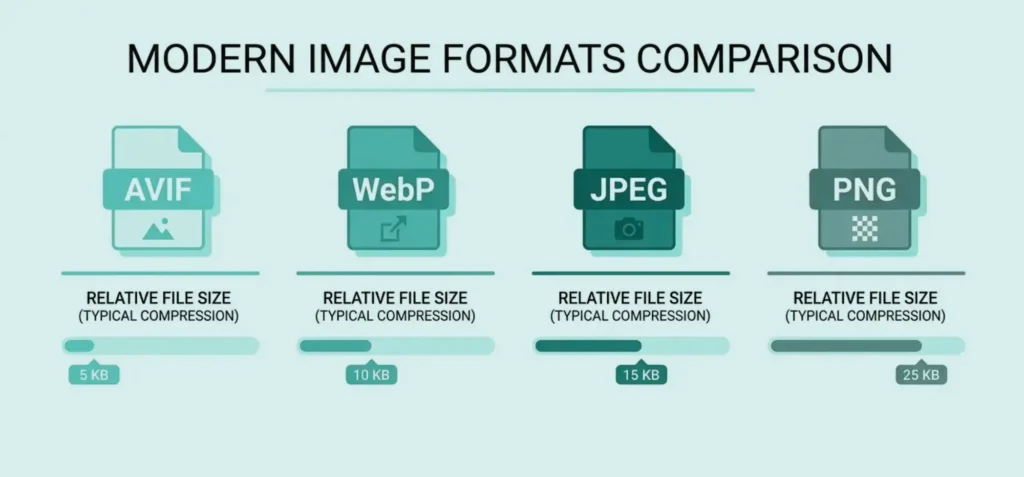
Using these formats, a 10MB image can shrink down to a tiny 150kilobyte (KB) before uploading. The website will not only load at a lightning speed but the graphics will still look absolutely stunning, and google will definitely reward the site with a much higher ranking, considering other conditions are met. join our mailing list to get updates on our future blogs.
