
While google search bots may be incredibly smart, they have one major limitation; they are technically blind. They possess the ability to crawl billions of web pages in seconds, but when they encounter a super cool graphic like that of a dog skateboarding on ice, they can’t actually see the colors, the skateboard, the helmet of the incredible face of the elated dog. To a search engine, all these brilliant graphics are just a mere blank box with a piece of code, unless we explicitly let them know what it is. This is where the magic of Alt Text come into play. Let’s look into it, how it works, why it matters for search engine optimization (SEO), and how to write it like a pro. Describing a Meme over the Phone Imagine a scenario where a friend has sent you a meme they find amusing. They’re there laughing hysterically saying, “Oh my god, you have to check the meme I just sent you.” You open it up but it won’t load. You’re there staring at a blank box while your buddy on the other side is dying of laughter waiting for you to get the gist. If they tell you “It’s a picture of a dog,” you will get the idea but you will still be lost. You still have no idea what’s happening, why it’s funny or why they are laughing their hearts out. But if they say, “it’s a picture of an angry white dog celebrating its birthday,” you can instantly picture the absurdity in your mind. Now you’ll get the joke. That is exactly what Alt Text (alternative text) does. Alt text is a short, descriptive snippet embedded in a website’s code that explains what is happening inside and image. It is the bridge for people who, for some reasons, can’t see the visual. It’s crucial for web accessibility-allowing screen readers to narrate images to the visually impaired users-and also helps the search engines understand your content. You don’t have to leave your audience with just a “picture of a dog.” Give them the whole context. Getting found in Google Images When you write short, accurate descriptions inside you image configurations, you give google the context it craves. The search engineer will read the alt text fully to understand the topic of your webpage. If your blog post is about pet hobbies, and your images have detailed alt texts confirming that, Google will feel much more confident in ranking your page higher for related searches. To make it even better, proper alt text is the number one way to get your website’s visuals featured in Google images. A substantial amount of web traffic comes from people searching visuals first. If your graphic does not have an alt text, it simply won’t show up in those image results, costing you thousands of potential visitors. Drop the Generic Names The absolute golden rule of web design is simple; never leave your alt text area blank, and never use generic file names. You are throwing away free SEO points if you upload a graphic and the alt texts are set to something default like “image-5.jpg” or “dog.jpg.” Instead, be descriptive and honest. Instead of “dog.jpg,” you might say “a supercool dog with blue helmet skateboarding on ice.” If it makes sense naturally, you can slide in specific keyword (like a specific brand or service you are talking about). Keep it honest and do not stuff random keywords into the text if they don’t actually match the picture because google can easily spot a spammy trick from miles away. About the Author: Brian Ouma is a Web Developer, Graphic Designer, and Digital Strategist who builds beautiful websites engineered to rank on page one. He specializes in blending stunning visuals with clean, fast code to help brands grow online. Want to make sure your graphics aren't secretly slowing down your SEO? Let’s connect and speed up your site!

How Google Search bots work

While Google search bots may be incredibly smart, they have one major limitation: they are technically blind.

They possess the ability to crawl billions of web pages in seconds, but when they encounter a super cool graphic like that of a dog skateboarding on ice, they can’t actually see the colors, the skateboard, the helmet, or the incredible face of the elated dog. To a search engine, all these brilliant graphics are just a mere blank box with a piece of code, unless we explicitly let them know what it is.

This is where the magic of alt text comes into play. Let’s look into it, how it works, why it matters for search engine optimization (SEO), and how to write it like a pro.

Describing a Meme over the Phone

Imagine a scenario where a friend has sent you a meme they find amusing. They’re there, laughing hysterically, saying, “Oh my god, you have to check the meme I just sent you.” You open it up, but it won’t load. You’re there staring at a blank box while your buddy on the other side is dying of laughter waiting for you to get the gist.

If they tell you, “It’s a picture of a dog,” you will get the idea, but you will still be lost. You still have no idea what’s happening, why it’s funny, or why they are laughing their hearts out. But if they say, “It’s a picture of an angry dog celebrating its birthday,” you can instantly picture the absurdity in your mind. Now you’ll get the joke.

That is exactly what alt text (alternative text) does.

Alt text is a short, descriptive snippet embedded in a website’s code that explains what is happening inside an image. It is the bridge for people who, for some reasons, can’t see the visual. It’s crucial for web accessibility—allowing screen readers to narrate images to the visually impaired users—and also helps the search engines understand your content.

You don’t have to leave your audience with just a “picture of a dog.” Give them the whole context.

Google finding your images

When you write short, accurate descriptions inside your image configurations, you give Google the context it craves.

The search engine will read the alt text fully to understand the topic of your webpage. If your blog post is about pet hobbies, and your images have detailed alt texts confirming that, Google will feel much more confident in ranking your page higher for related searches.

To make it even better, proper alt text is the number one way to get your website’s visuals featured in Google images. A substantial amount of web traffic comes from people searching visuals first. If your graphic does not have an alt text, it simply won’t show up in those image results, costing you thousands of potential visitors.

Also Read: Why Huge Images Are Ruining Your Vibe (And Your Google Ranking)

Drop the Generic Names

The absolute golden rule of web design is simple; never leave your alt text area blank, and never use generic file names.

You are throwing away free SEO points if you upload a graphic and the alt texts are set to something default like “image-5.jpg” or “dog.jpg.” Instead, be descriptive and honest. Instead of “dog.jpg,” you might say, “a supercool dog with a blue helmet skateboarding on ice.”
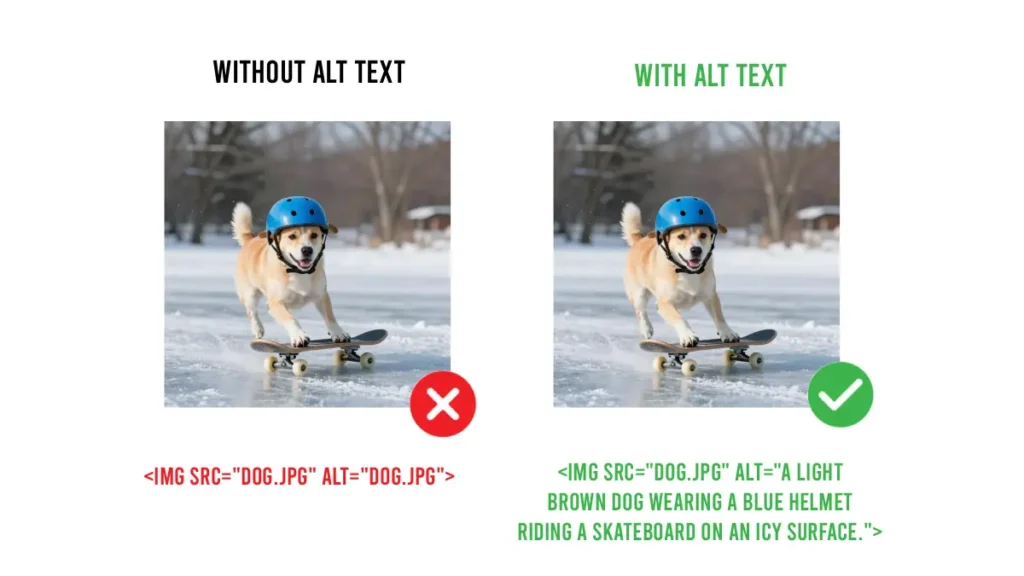
How Google "Sees" Pictures: The Secret Magic of Alt Text

If it makes sense naturally, you can slide in a specific keyword (like a specific brand or service you are talking about). Keep it honest and do not stuff random keywords into the text if they don’t actually match the picture because Google can easily spot a spammy trick from miles away.

Author: Brian Ouma

Brian is a Nairobi-based web developer and graphic designer with nearly a decade of experience in crafting digital experiences. Since 2016, I have delivered hundreds of visual designs—spanning both web and graphic projects—while navigating the complexities of solo freelancing and fast-paced agency collaborations.